
DEBUNKING THE “RELIGIOUS ETHNOSTATE” MALARKEY
One of the biggest self-owns of the “pro-Palestine” crowd is their ignorance about what a Jew is.

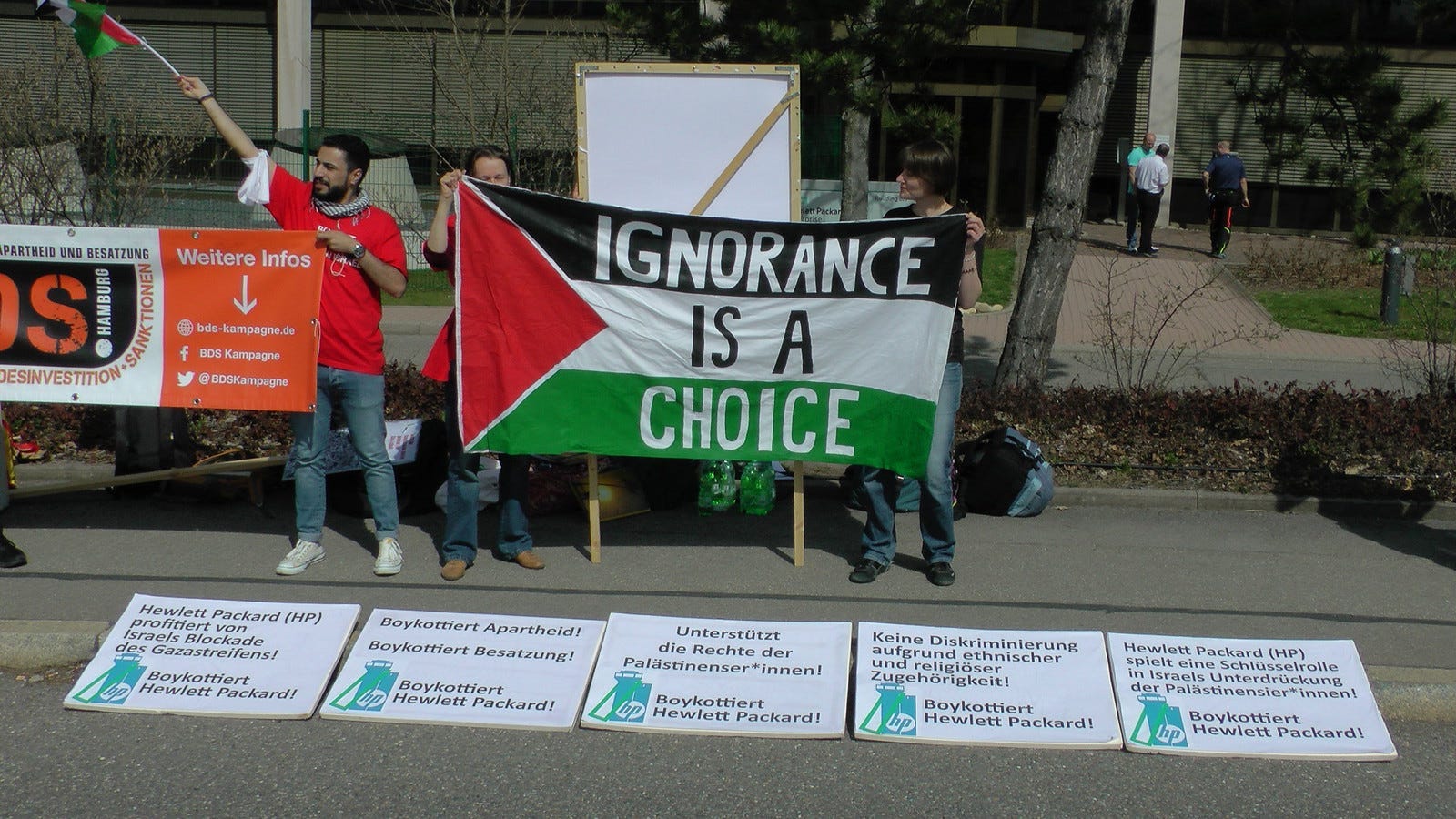
If the IQs of some anti-Israel activists were any lower, we’d have to water them twice a day.
The entire anti-Israel (or, as they speciously formulate it, the “pro-Palestinian”) narrative is founded on false history, outright lies and, in one particularly foundational case, utter ignorance.
One of the core premises of antizionism is that Israel does not have a right to exist because religions do not deserve countries.
Like so much of the anti-Israel narrative, this is founded entirely on obliviousness.
Some particularly stupid activists have taken to calling Israel a “religious ethnostate,” which is especially ironic in a region where actual religious ethnostates proliferate.
If activists believed that “religions do not deserve countries,” they would be railing against scores of other countries and leaving Israel alone. They sure as hell would not be marching with signs reading “Hands off Iran,” for example.
What they mean, in fact, is that religions do not deserve countries if the religion is Jewish. They have no problem with the 26 states that have Islam as an official religion — even when that religion is used as a justification to oppress hundreds of millions people (women most notably but pretty much everyone, since the EIU Democracy Index calls 23 of the 26 Islamic countries “authoritarian or not meaningfully democratic.” The other three are classified as “partial/flawed/hybrid democracies.”)
There are 13 officially Christian countries, two officially Buddhist countries and one officially Jewish country.
The United Kingdom has a state religion: Anglican Christianity. King Charles, the head of state of my country, Canada, is also head of state church.
Israel, of course, is a pluralist, multicultural country with freedom of religion. Far from a “religious ethnostate,” Israel is probably closest by comparison with the UK. The country has a religious cultural imprimatur, but constitutionally (though neither the UK nor Israel have written constitutions) every citizen is equal, in the imperfect way that all democracies strive for but inevitably fail in ensuring the utopia of perfect equality.
With Israel, though, the ignorance goes so much deeper. It’s not just Israel these people belligerently misrepresent. It’s Jews.
Jewishness is not simply a religion.
Judaism is a religion, certainly — but Jewish identity is also a peoplehood, an ethnicity, a culture, a shared history, and a civilization that predates modern categories. Jews have a common language, traditions, a collective memory tied to a specific geography, and a continuous identity that has persisted across millennia, often in exile from that geography. Long before modern nationalism, Jews referred to themselves as a people, not merely adherents to a religion.
This was typical of the ancient Near East. Almost all people identified with a theology that was shared by their ethnic group.
Because they are proselytizing faiths, Islam and Christianity had to deracinate themselves from their ethnic roots in order to expand (whether by voluntary or forced conversion). Judaism, which does not seek converts, never did that. That has allowed activists who are ignorant of history and cultural diversity to condemn Israel as a “religious ethnostate.”
Conversely, it’s why so many of the loudest voices screaming against Israel are Pakistani, Indonesian or from other places where they clearly have no skin in the Palestine game except for shared religious supremacism.
But the ethnoreligious nature of Judaism is not entirely unknown today among other peoples. Sikhs, Druze, Yazidis, Samaritans, Zoroastrians/Parsis, and Mandaeans, among others, are peoples whose spirituality, law, land, and peoplehood are integrated.
It’s especially ironic that a bunch of the people who insist there are as many as 64 definitions of gender say that Jews must fit in one of two boxes: religion or ethnicity.
The University of Toronto, whose campuses shamefully birthed the annual atrocity of misinformation called Israel Apartheid Week, acknowledges a multiplicity of gender identities and advises on how to respectfully acknowledge and address this diversity. But try having a discussion about Jewish identity and the Jewish people’s inherent connections to the land of Israel on the U of T campus or any other university in North America and you will likely be surrounded by students (and even faculty) telling you what a Jew is, the parameters of their rights to self-determination and, often, a fabricated historical narrative that asserts that Jews have no right, or even connection to, the lands that are their unceded indigenous territories.
This matters, because the claim that Israel is “just” a religious state rests on a category error. If Judaism were purely analogous to, say, Christianity or Islam as practiced by most adherents today — primarily a set of beliefs detached from national identity — the argument might carry more weight.
But it is not.
The fact that Judaism includes religious practice does not negate the national dimension of Jewish identity; it is part of how that identity has been maintained.
Why, then, does the argument arise so forcefully in the case of Israel?
It’s not religious ethnostates that are the problem, clearly — this is evidenced by the selfsame activists who condemn Israel actively defending the right of the Islamic theocracy of Iran to continue unmolested in oppressing its people. Less actively, but no less hypocritically, they do not waste a moment’s energy agitating against actual religious ethnostates.
The problem is a Jewish state.
It is this “religious ethnostate” thesis that magnificently unravels the whole “antizionism is not antisemitism” extravaganza. Antizionism is antisemitic in a million ways that go beyond the simplistic “I hate Israel because I hate Jews” tableau. Just as Judaism is more complicated than some identities, antisemitism is a more complicated form of racism. (Even the term “racism” is inapt, since Jews are not a race. I use the term, though, because antisemitism acts as racism. And because it allows me to call ignorant antizionists what they are. It’s complicated.)
The modern international system is built on the premise that peoples — however defined — have the right to govern themselves in some form. That right is not contingent on the purity of their political structure or the absence of religious influence. It is a recognition that groups with shared identity, history, and connection to land may legitimately seek political expression.
That principle is messy. It produces contradictions. It leads to difficult questions about borders, minorities, and competing claims. It is not applied perfectly anywhere.
Israel is not an exception to that complexity; it is an example of it.
It is a state that defines itself as Jewish and democratic, and those two elements exist in tension, as they do in many countries that balance majority identity with minority rights. It is a society that includes religious and secular Jews, as well as significant non-Jewish minorities. It is engaged in an ongoing conflict that raises serious moral, political, and humanitarian questions.
None of that is irrelevant.
But none of it negates the underlying principle: that Jews, as a people, have a legitimate claim to self-determination, just as other peoples do.
To deny that claim on the grounds that Jewish identity includes religion is to apply a standard that is not applied elsewhere. It is to treat Jewish national expression as uniquely suspect, even as similar expressions are accepted or accommodated.
This does not mean that Israel should be beyond criticism (a disclaimer we Zionists are forced to make all the time and that, for some freaky reason, those who actively or passively defend scores of tyrannical states feel no obligation to utter).
But there is a distinction between criticizing a state and denying its right to exist.
The former is part of normal political discourse. The latter raises deeper questions about consistency and principle.
And let’s be clear on terms here: Antizionism is the negation of the Jewish people’s right to self-determination.
If one believes that no state should have any religious character whatsoever, that is a position one can attempt to defend. But it would require rethinking not only Israel, but a significant portion of the global political landscape, including many countries that are rarely, if ever, subjected to the same scrutiny.
In practice, that argument is almost never applied universally.
Which is why it often appears less as a general principle and more as a targeted objection. An obsession even. An obsession with the one state of the one people who have obsessed their neighbors for millennia.
The conversation about Israel is difficult precisely because it sits at the intersection of so many issues: religion, nationalism, history, identity, conflict.
Oh. And, not incidentally, Jews.
In fact, it’s really not so complicated. It’s not so much about religion, nationalism, history, identity, conflict — those things exist almost anywhere one cares to look in the world.
You know what doesn’t?
Jews.
Jews have been ethnically cleansed from almost everywhere in the world.
If anything, that fact underscores why the principle of self-determination exists for Jews. Because they have not been safe in places where they lack self-determination. (They are also, it turns out, not safe where they do have self-determination, which is yet another hypocritical reality that doesn’t bother the very people who cheered on the baby beheaders, live immolators, rapists and mass murderers who perpetrated October 7.)
But the principle of self-determination exists for all peoples: to allow everyone, in all their complexity, to define their own political futures. (And if your response is, “What about Palestinians?” you’re showing your ignorance yet again. It’s not Israel that has prevented Palestinian self-determination, it’s Palestinian, Arab and Muslim elites. If someone is not clear on that, they are not informed enough to be engaged in this discussion. Though that never seems to stop them. On the contrary, ignorance seems to act as an accelerant to their fanaticism.)
The most infuriating aspects of the antizionist “pro-Palestinian” movement is the certainty of ignorant people, the selectivity of their umbrage, their self-righteousness in their wrongness, the application of condemnatory epithets where they do not fit and the utter unconcern about the places where those epithets actually apply.
In short, it is the foundational premise of antizionism that Jews do not deserve to exist based on the fact that antizionists are too stubbornly stupid to understand the nature of Jewish identity.
If there is a better definition of racism in practice, I can’t imagine it.
Some people have generously asked me to make it possible to make one-time contributions to support my work. I have now set up a PayPal link for donations. If you like snappy smackdowns of antisemitism and anti-Zionism and want me to keep it up, any support is deeply appreciated. Click here.
*
Follow me on Facebook: https://www.facebook.com/profile.php?id=61588402258315
Follow me on Insta: https://www.instagram.com/patsshtick/
Follow me on X: https://x.com/PatsShtick
Pat, you really hit the nail on the head here. Years ago I was taught a simple rule: if you explain something honestly to someone twice and they still refuse to acknowledge the reality, then you are no longer dealing with misunderstanding — you are dealing with hostility, bias, or outright antisemitism.
The double standard is just impossible to ignore. There are actual religious states in the Middle East with explicit religious laws, restrictions, unequal treatment, limitations on speech, gender inequality, bans on alcohol, restrictions on non-Muslims, and far less freedom overall — yet the obsessive outrage is directed almost exclusively at Israel, which is actually a democratic, pluralistic society with freedom of religion, elections, courts, opposition parties, Arab citizens, LGBTQ rights, and open political dissent.
At some point, the inversion becomes so extreme that you realize facts alone are not the issue anymore.
And honestly, one of the hardest realities is exactly what you touched on: even when people like you write strong articles and others try to push back, there are still massive institutional forces shaping public perception in the opposite direction — media framing, activist culture, universities, influencers, social media ecosystems, and constant repetition of emotionally charged narratives. That makes the battle far bigger than one argument or one article at a time.
Pro-Jew. Proudly Zionist.
This is one of the shallower of the shallow antizionist articles — particularly for Pakistanis to be making. About a million people were killed and 14 million displaced, right around the time the Jewish community in Palestine was fighting for its lives, all so that Muslims in India could have their own state.