
HAS THE WORLD GONE MAD?
The genocide libel is a symptom of a society gone off the rails. Either we get the train on track or expect much, much worse.

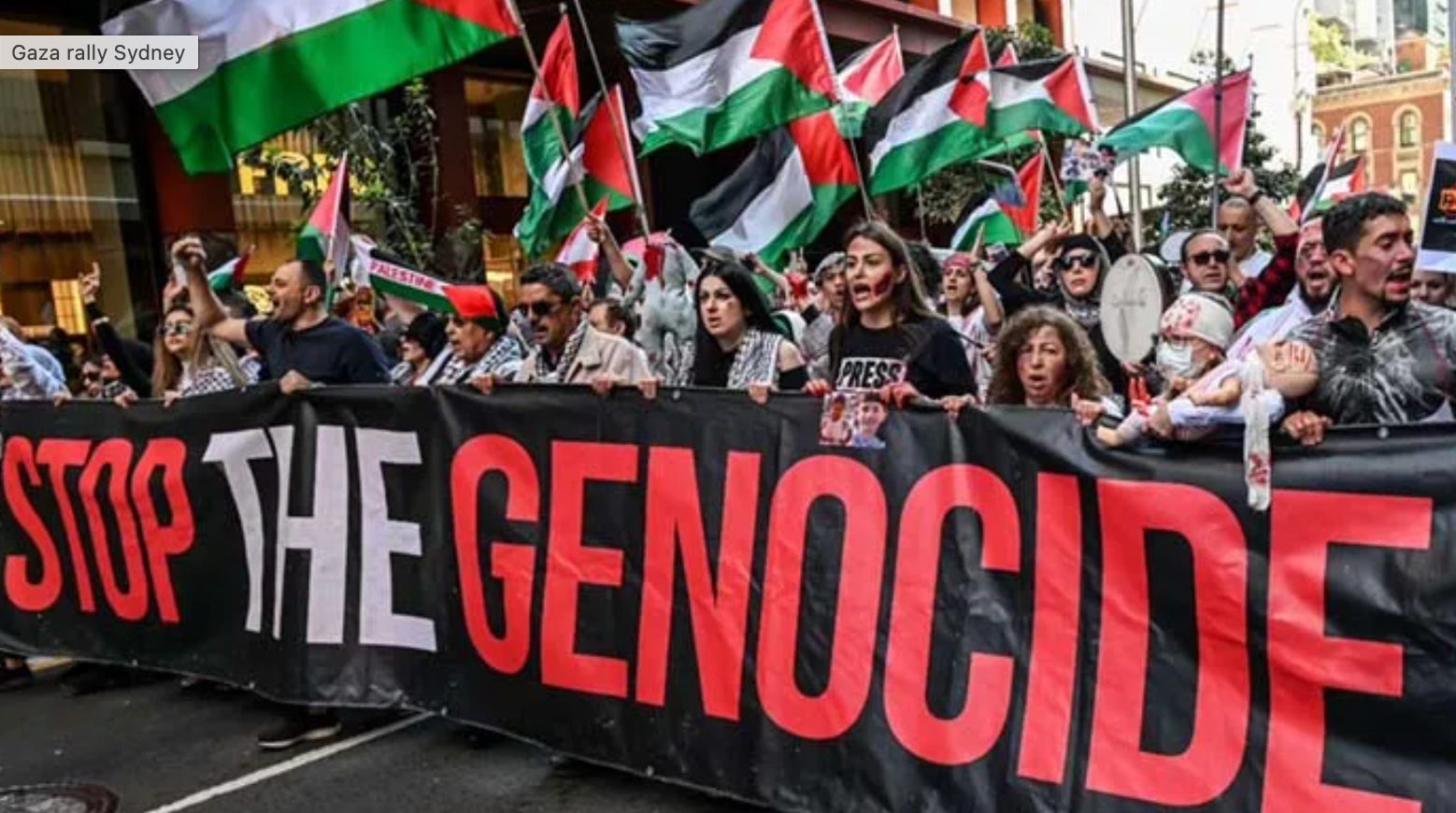
I am not going to provide evidence that Israel is not committing genocide in Gaza. As I have written multiple times, if you believe Israel is committing genocide, you either do not understand the definition of the term, or you have no idea what is happening in Gaza.
What I am addressing here is why this despicable falsehood has so successfully taken root.
Let’s get the easy part out of the way.
Jews.
George Orwell wrote that antisemitism leads people to believe things “which could not possibly be true.”
Jewish space lasers. Mossad-trained attack sharks. Rape dogs. Apartheid. Genocide.
These are allegations that would be laughed out of intelligent society if they were aimed at any other group.
Accuse Jews of these sci-fi, dystopian, fictionalized fantasies and senior elected officials, the UN, credulous media, and millions worldwide hear them and nod. Specially trained IDF rape dogs? Yes, that sounds about right. Let’s run that in the New York Times.
But the commodification and corruption of Holocaust memory deserve a deeper dive.
There is something profoundly sick about the way Holocaust memory is being used right now. It is not simply that people misunderstand history, or that they reach for analogies that are strained or ill-fitting. It is that one of the most specific, documented, and morally consequential events in human history is being stripped of its meaning and repurposed as bargain-basement political rhetoric. Nowhere is this more contemptible than in the phenomenon of Holocaust inversion — the claim, rampant in erstwhile sensible circles, that Israelis are the new Nazis and Palestinians the new Jews.
This is not merely a provocative comparison or an overreach born of perverted passion. It is a lie that spits on the most sacred history, and it represents a massive ethical societal failure.
Our civilization, at one point, at least gave lip service to the idea that this history needed to be remembered and respected because, to do otherwise, risked failing to learn its existential lessons.
Now, all morality, lessons, and bets are off. If that history can be mobilized in service of attacking the descendants of its victims, it’s fair game.
To collapse the reality of the Holocaust into a handy shorthand for contemporary political conflict is not to illuminate anything — it is to obscure everything. If everything is genocide, nothing is genocide. If we throw the word “holocaust” around every time a tank starts its engine, the world will yawn when actual genocides occur.
And, in fact, this is precisely what is happening today. Genocides are taking place right now, but the world is laser focused on a fake genocide.
Abusing the concept of “genocide” and “holocaust” for political advantage is immoral in the extreme. But to misuse these terms against the very people for whose historical experience the words had to be invented is a special kind of loathsomeness. But we live in a world where employing the most debased tactics against Jews is fair game. So let’s accept that playing field and move on.
What makes this development particularly striking is the context in which it occurs. We live in a time when ostensibly decent people are deeply attuned to language, representation, and historical sensitivity. Entire frameworks have been built around the idea that the experiences of marginalized groups should not be appropriated, trivialized, or repurposed.
The language of harm, of erasure, of misrepresentation has become central to how many people understand justice. And yet, when it comes to the Holocaust, those norms go straight down the shitter. Everyone’s historical experiences are sacred … except Jews’.
Why is this particular history treated differently, why is its specificity is so readily sacrificed, and why are its symbols considered available for reinterpretation in a way that would be unacceptable elsewhere?
To be fair, part of the answer lies in the rhetorical power of the Holocaust itself. It occupies a unique place in the moral imagination of the modern world. It is widely understood as a benchmark of absolute evil, a point beyond which moral language struggles to go. To invoke it is to claim a kind of moral clarity, to position oneself on the side of ultimate victims against ultimate perpetrators.
Holocaust inversion leverages that power by transferring it. It takes the moral weight associated with the genocide of European Jews and redirects it, recasting contemporary actors in those roles. In doing so, it elevates one side of a conflict to the status of unparalleled victimhood while simultaneously assigning the other the role of history’s most reviled villain. This is not an act of neutral comparison; it is a deliberate moral reframing that seeks to shut down debate by invoking the most extreme categories available.
The problem is not simply that the analogy is utter bullshit, although it is. The deeper issue is that it transforms a concrete historical event into an emblematic shorthand, detaching it from the conditions that made it possible. The Holocaust becomes less a specific occurrence rooted in time, place, and ideology, and more a floating signifier for “injustice at its worst.” Once that shift occurs, its meaning can be reassigned at will, its victims and perpetrators swapped according to the needs of the argument. The result is not greater understanding, but a flattening of history that ultimately undermines the very moral clarity it seeks to claim.
This flattening has consequences. It erodes the distinctiveness of the Holocaust as a historical event, making it more difficult to understand the particular mechanisms and ideologies that produced it. It also places Jews in a uniquely disorienting position, in which their historical trauma is invoked not to foster empathy or recognition, but to indict them. The experience that has shaped so much of modern Jewish identity and vulnerability is reframed as evidence against them.
At the same time, the use of Holocaust inversion conveniently bypasses the complexities of the present. Contemporary conflicts, including those involving Israel and the Palestinians, are intricate, shaped by history, politics, security concerns, and competing narratives of legitimacy and grievance. Reducing such a conflict to a simple equation of “Nazis” and “Jews” does not clarify these dynamics; it replaces them with a ludicrous caricature. It suggests that one need not engage with nuance, evidence, or competing claims, because the analogy itself has already settled the question.
What is particularly troubling is how this form of rhetoric is often framed as a moral imperative. Those who employ it frequently see themselves as engaged in a necessary act of witnessing, drawing attention to what they perceive as injustice by invoking the strongest possible language. Yet moral urgency does not justify historical distortion. On the contrary, the more serious the claim, the greater the responsibility to ensure that it is grounded in reality.
Today, people who seek to correct this gross misuse of history are called “genocide deniers.” Bad actors invent a genocide that doesn’t exist, then slander those who refuse to drink the Kool-Aid with the most contemptible smear.
What is at stake, ultimately, is not only the integrity of historical memory, but the standards by which we conduct moral and political discourse.
If we take seriously the idea that histories of suffering should not be appropriated or distorted, then that principle must apply universally, including — especially — to the Holocaust.
The abuse of Holocaust memory is more than just bad people using inappropriate language.
The swath of erstwhile legitimate voices propagating the genocide libel is a symptom of a society gone off the rails.
This is not just a bad choice. It is — or, at least, it should be — a disqualifying decision.
Anyone who perpetrates the genocide lie should be excluded from elected office, from teaching, from any leadership role, from decent society.
Instead, we are conversely in a place where anyone who does not swallow and then regurgitate the fiction is excommunicated.
That is a symptom of a society gone off the rails.
Either we set that train back on track or things will get much, much worse.
Follow me on Facebook: https://www.facebook.com/profile.php?id=61588402258315
Follow me on Insta: https://www.instagram.com/patsshtick/
Follow me on X: https://x.com/PatsShtick
*
Some people have generously asked me to make it possible to make one-time contributions to support my work. I have now set up a PayPal link for donations. If you like snappy smackdowns of antisemitism and anti-Zionism and want me to keep it up, any support is deeply appreciated. Click here.
The western world made the decision to import millions of Muslims from vehemently antisemitic countries. Not surprisingly, these newcomers brought their hatred and intolerance with them. For political reasons, they are now being catered to and that isn’t going to stop anytime soon. To put it bluntly, the atmosphere of simmering Jew hatred that manifests, in part, as hatred of Israel is the new normal. Jewish people throughout the western world are now going to have to reevaluate their options in light of this (and many likely are already doing so). The choice is very personal. How much are you willing to accept before some line is crossed and you realize that it’s time to go. Grim stuff.
It's hard to be hopeful at the moment.
Am Yisrael Chai 🇮🇱
From a proud Irish Zionist