
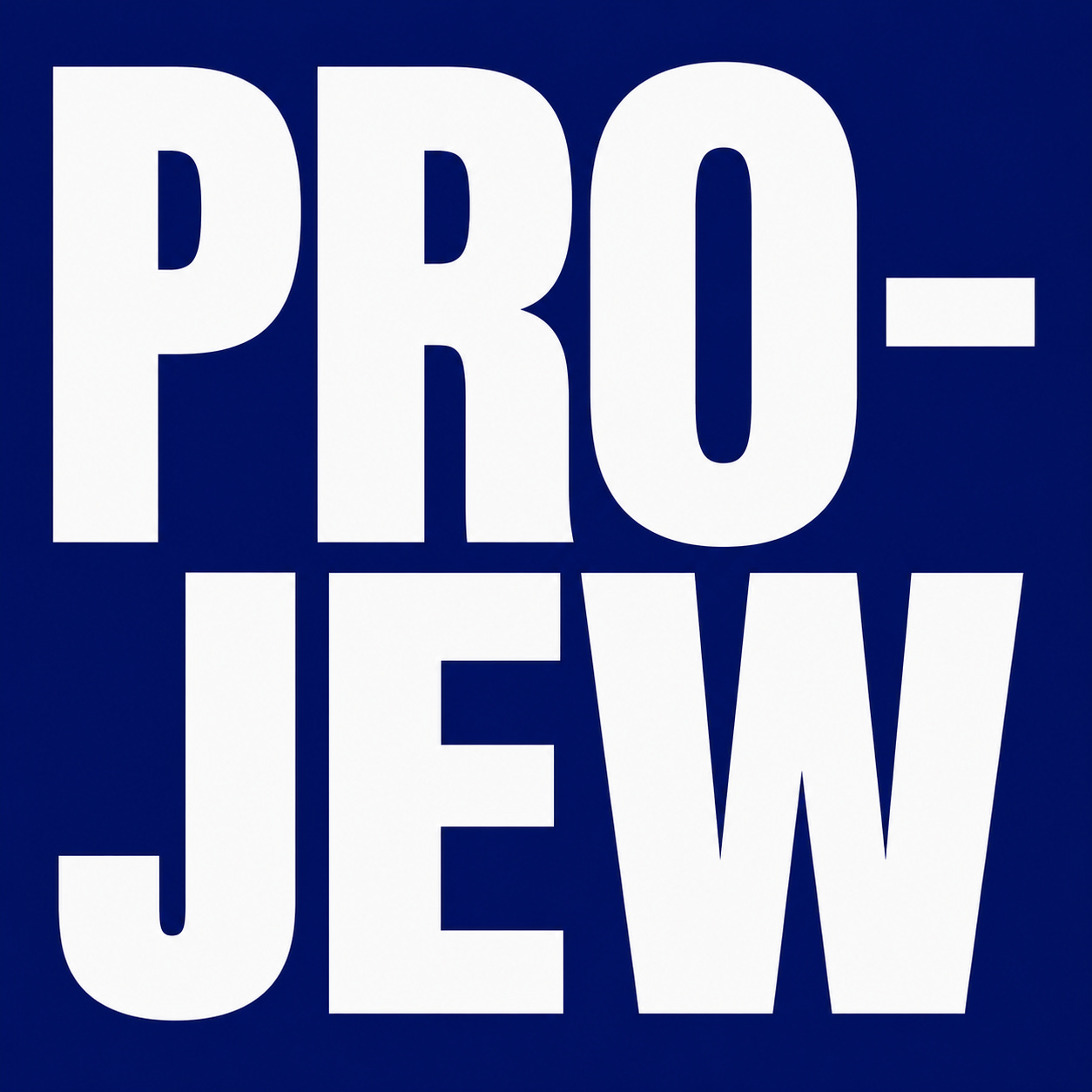
IT’S SIMPLE: I’M PRO-JEW
We have a nomenclature problem. Until something better comes along, this is my solution.

In spite of the hundreds of thousands of words that have poured out of me on the subject of antisemitism and how to fight it, I struggle with a fundamental problem in the nomenclature.
Our side does not have a snappy slogan like “Free Palestine” (however ludicrously specious that one may be). The absence of a clear message is a big problem. We inevitably fall back on negatives. We oppose antisemitism.
If we had a slogan, it would be “Jews have a right to live in peace,” which is defensive and, frankly, ridiculous. It is ridiculous that we have to say this.
Another nomenclature thing: How do non-Jewish people like me self-define in the context of the current cataclysm of antisemitism in the world?
I am a Zionist. For sure.
While I would argue that in order to be an ally of Jewish people, you also need to be a Zionist, I am more than just a Zionist. I am an ally of Jewish people — in Israel and everywhere else.
I am an “ally of Jews,” which is a weird formulation. But Google a slightly smoother formulation—”Jewish ally”—and you will find a million results addressing examples of Jewish people being allies to other groups and almost nothing in terms of non-Jews being allies to Jewish people.
This is, obviously, a stark statement on the relationship between Jewish people and the larger society. It speaks to the unequal relationship among Jews and social justice communities, to which Jewish people have contributed for decades but which have largely abandoned them — or worse — at this cataclysmic moment.
Then, last week, I was at lunch with two friends and, in casual conversation, one of them dropped the phrase “Pro-Jew.”
I leapt on it instantly.
It’s so simple. Why hadn’t I thought of this before?
In the early days of the gay rights movement, before we adopted the expanding acronyms, we used to use terms like “pro-gay” or more commonly “gay-positive,” to refer to politicians and other allies.
I love the phrase “Pro-Jew.” I like that it also is faintly ridiculous, in the sense that, who wouldn’t be “Pro-Jew”?
And that’s the beauty of the question: it answers itself.
Anti-Jews.
It’s about as perfect as can be.
(On the flipside, “Jew-positive,” as pleasant sounding as that may be, sounds faintly diagnostic to me. “How am I, Doc?” “Well, I’ve got the results here and it appears you’re Jew-positive. Fortunately, it seems we’ve caught it in the early stages.”)
The magnificent simplicity of “Pro-Jew” also resolves the related nomenclature problem I’ve been struggling with.
I am anti-antisemitic.
Obviously, this is a mouthful. It is a double negative. It is, simply, unsustainable.
As the other friend at lunch the other day said, there has always been the term “philosemitic.” But this term is not the same as “Pro-Jew.” In fact, it’s quite problematic.
Philo means “love of,” “fondness for,” or “attraction to,” from ancient Greek.
This is, obviously, an emotional response as much as anything. Plus, you shouldn’t need to love, be fond of, or be attracted to Jews in order to stand as an ally.
I work with an animal organization and I avoid the term “animal-lover,” which is often used in the context. I prefer “animal ally.” Because you shouldn’t need to love animals in order to support laws and social norms that ensure animals are not abused or mistreated.
Likewise with Jews. (Though I hate to say it, given the history of reverse anthropomorphizing, in which Jews have been equated with animals.)
The larger problem that I have always had with philosemitism is that it is sort of the flipside of the same coin.
Both imply that one has a response to Jewish people as a group — based on either some innate characteristic on their part or some inherent prejudice (positive or negative) on one’s own part.
In other words, antisemitism (“All Jews are bad”) is, to me, merely the flipside of philosemitism (“All Jews are good).”
No sentence should ever begin with “All [any group of people] …”
The phrase “Pro-Jew” implies some sort of intellectual or at least cognitive process by which one has assessed the alternatives and decided to stand with, support, defend, or otherwise ally with Jewish people. It doesn’t suggest any blanket assessment about Jewish people themselves.
It does, though, imply a position, a line in the sand, a flag in the ground.
I like the dynamic it sets up.
I am Pro-Jew.
If you are not, that’s your problem.
But, because I am Pro-Jew, and you are not, I will make that my problem.
*
Follow me on Facebook: https://www.facebook.com/profile.php?id=61588402258315
Follow me on Insta: https://www.instagram.com/patsshtick/
Follow me on X: https://x.com/PatsShtick
*
Some people have generously asked me to make it possible to make one-time contributions to support my work. I have now set up a PayPal link for donations. If you like snappy smackdowns of antisemitism and anti-Zionism and want me to keep it up, any support is deeply appreciated. Click here.
We like it. It's simple and says what it means, and like you said, what's the opposite? Put the "anti-Jews" on the back foot having to answer that. In fact, I'm going to use anti-Jew instead of "antisemitism" from here on out.
A friend posted once on FB that she was "pro-Jew," so I think you're onto something.
Have added Pro-Jew to my personal lexicon. I’m Jewish and Pro-Jew unlike those self-proclaimed Jews who hate Israel.