
STOP ARGUING. RIDICULE.
Reason isn’t working on young “pro-Palestinian” activists. Will mockery?

I’ve been reading a book about persuasion, and one idea in particular has stuck with me.
When you tell people what to think — especially when you tell them what not to think — you often trigger what psychologists call a kind of “anti-persuasion reflex.” It’s the instinctive resistance people feel when they sense their freedom is being constrained. Even if the advice is in their best interest, even if it’s obviously correct, something inside them pushes back.
“Don’t tell me what to do.”
Teenagers know smoking is harmful. And yet many still try it — not in spite of that knowledge, but because of it. The prohibition itself becomes part of the appeal. It transforms the act from a bad decision into a statement of independence.
This is especially relevant to young people, who surveys indicate are the most antizionist and antisemitic age demographic.
To be clear, if you’re trying to confront antisemitism or antizionism today, it is not facts that present our greatest obstacle. It’s that anti-persuasion reflex.
Facts don’t matter to adherents of the Palestinian narrative. If they did, the Palestinian narrative, as it exists today, wouldn’t exist at all. They have built an anti-apartheid movement where there is no apartheid, an anti-genocide movement where there is no genocide. It’s a house built on lies.
So when we say, “this is antisemitic,” or “this crosses a line,” we may be entirely correct. But what some people hear is something different: You are not allowed to think this way. And for a people who define themselves through autonomy, identity, and resistance to authority (which is what every generation of young people struggles to do), that message can have the opposite effect.
Instead of discouraging the behavior, it can reinforce it.
This helps explain a phenomenon that, on its face, is difficult to make sense of. We live in a world where hundreds of millions of people are facing humanitarian crises — war, famine, displacement, repression — across multiple continents. And yet, for a significant portion of young activists, only one conflict seems to matter. Only one international issue grabs their attention.
For many young people (perhaps for all people, but especially for young people), political engagement is not just about policy outcomes. It is a way of expressing who they are. They communicate belonging, values, and independence from the previous generation.
And here is where history enters the picture in a complicated way.
For their parents and grandparents, antisemitism was tied to the most catastrophic event of the modern era. The Holocaust gave antisemitism a uniquely toxic reputation. To be associated with it was to be morally disqualified.
For some younger activists, antisemitism functions differently. The stigma has not disappeared, but it has been reframed. In certain circles, accusations of antisemitism are not experienced as warnings — they are interpreted as attempts to silence dissent.
And if you already have an anti-persuasion reflex, that dynamic can invert the incentive structure.
If you tell them that antisemitism is the third rail of our civilization, goddamned if they are not going to reach for it, consequences be damned. The taboo becomes the incentive.
Being told “don’t cross this line” doesn’t always deter people. Sometimes, it signals where the line is — and invites people to step over it.
Sorry to be the old codger here, but remember: this is a generation that needs to go to greater and greater lengths to shock the oldsters. Their grandparents were not permitted to wear jeans to school (“Dungarees,” as me old Da used to call them). Now they attend class in pyjama bottoms and crop tops, defiantly displaying their navel piercings, face tattoos and haircuts that look like they do their own coif with a blunt meat cleaver.
Significantly, the Palestinian narrative is almost entirely oppositional. It is defined less by a clear, constructive vision for Palestinian self-determination and more by a stance against Israel — and Jews.
And how perfect is Palestinianism for a generation like this?
How fitting for a generation whose constructive worldview can be summed up as “Burn it all down.”
And how convenient that it’s the Jewish state that we’re talking about here?
Gramps may have come back from the war after liberating Europe and told the young’uns about the catastrophic potential of antisemitism. How better, then, to differentiate oneself from the orthodoxies of the past than to behave not only as a bull in a china shop, but to do so on the one topic a half-century of decent society agreed was the one area where we should tread lightly?
Many activists today see themselves as courageous dissenters, speaking truth to power. They imagine themselves as small voices challenging a dominant system. It is an appealing self-image.
The sad joke here is that, rather than being little voices struggling to be heard over the repressive diktats of The Man, theirs is the dominant political message. Their views are the ones that are excluding genuinely dissenting voices from being heard. Their activism is the repressive, dominating, steamroller of consensus right now.
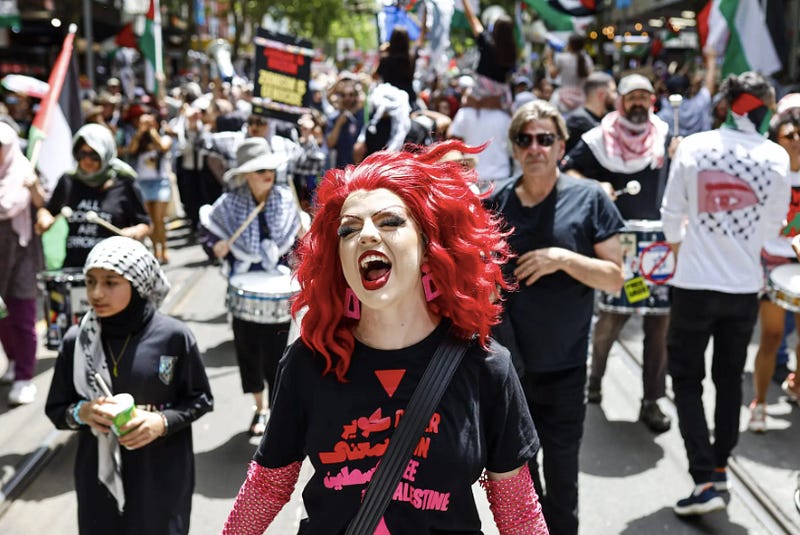
Over the past several years, “pro-Palestinian” demonstrations have overrun cities around the world, sometimes drawing tens or hundreds of thousands of participants. The cause is supported, rhetorically or diplomatically, by most of the world’s governments and, overwhelmingly, by the UN General Assembly, NGOs and commentators (as well as graffiti artists, terrorists and violent, racist thugs) worldwide.
This is not a fringe position.
Somehow, a cause adopted primarily as a way for individuals to assert their uniqueness — to differentiate themselves from the crowd — has managed instead to subsume them into arguably the most homogenizing mob of conformity in the world today. (Or ever, if you have a longer sense of antisemitism’s history, which these kids, of course, do not.)
Which brings us back to the problem of persuasion.
If simply telling people they are wrong can backfire — if it triggers resistance rather than reflection — then the challenge is to find a different approach.
We need a strategic change. Trying to talk sense into these oxymoronic conformist misfits doesn’t work.
Offense is sometimes the best defence and one of the things we can be doing is pointing out that these “activists” are not creating an identity based on individualism and speaking truth to power, but one based on mob conformity and speaking lies to victims of injustice.
Rational thought is not effective with these people.
Ridicule them.
Point out how they are the embodiment of conformity, the definition of useful idiots, the ideological equivalent of a bad haircut.
Dismiss them.
Don’t engage with their nonsense.
Don’t try to convince them.
Laugh at them.
Demean them.
Don’t give them the finger. Give them the L on the forehead.
Mock their TikTok education.
Text them a dropped pin for the local library.
Give them The Complete Idiot’s Guide to the Middle East Conflict for Christmas.
Will it work? Probably not. But reasoning with them isn’t working either.
Follow me on Facebook: https://www.facebook.com/profile.php?id=61588402258315
Follow me on Insta: https://www.instagram.com/patsshtick/
Follow me on X: https://x.com/PatsShtick
*
Some people have generously asked me to make it possible to make one-time contributions to support my work. I have now set up a PayPal link for donations. If you like snappy smackdowns of antisemitism and anti-Zionism and want me to keep it up, any support is deeply appreciated. Click here.
I love this strategy and am adopting it. As someone who taught for 45 years I'm hear to tell you that you are so right about today's young people wanting to see themselves as uncompromisingly "speaking truth to power." Everything that they consider to be against the status quo is valued as a truth and everything that supports the things their parents might value, such as peaceful coexistence with other humans, is seen as a lie meant to manipulate them. On FacebooK I have stopped trying to talk sense to them. Now I just post laughing emojis or say things like, "Whatever genocide supporter" followed by a bunch of laughing emojis. When they respond indignantly I post another laughing emoji. Maybe it doesn't do any good, but it makes me feel better.
NY Knicks have the greatest comeback in NBA finals history. On the way out of the game Jerry Seinfeld is approached by a pro-pali heckler. He asks Jerry "Can I get a free palestine?" Seinfeld responds "Palestine doesn't exist." Another great comeback.