
THE LOWELL FORMULATION™
The specifics of antisemitism may change. The pattern remains the same.

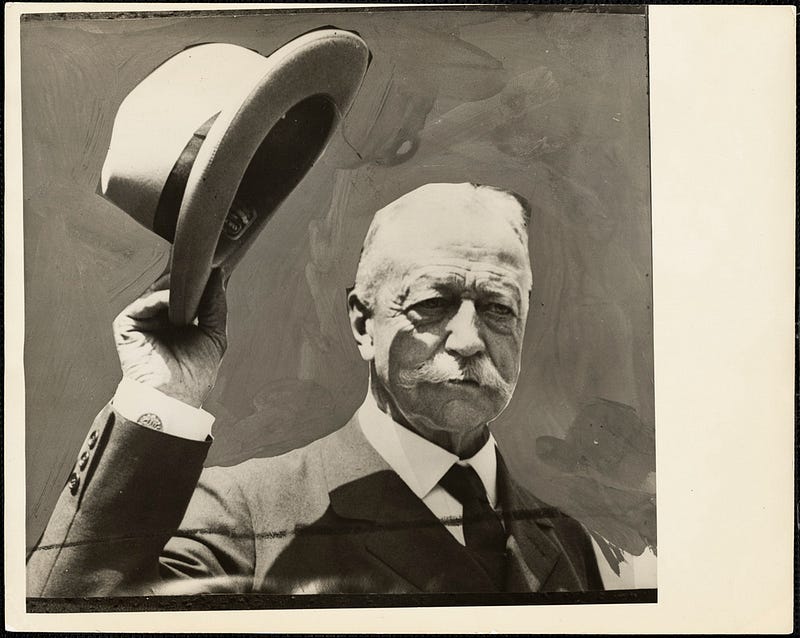
In the 1920s, A. Lawrence Lowell — president of Harvard University — faced what he believed was a problem: too many Jewish students.
Lowell apparently was not concerned about the Jews on his campus because they were unqualified. Quite the opposite. Jewish students were succeeding academically, which upset his conception of the apple cart of American opportunity.
Jewish success, in the eyes of antisemites, is rarely (or never) about application, hard work, dedication to study, intellect, or individual achievement.
It’s always part of some master scheme by Jews, some manipulative scenario in which The Jews have their thumbs on the scale, tipping the playing field in their favor and disadvantaging others.
So Lowell did what many universities of that era did, including my alma mater, McGill University. He set out to limit their numbers.
Lowell argued that Jews were overrepresented, that they were somehow gaming the system — essentially, that they worked too hard, that they were overly strategic, overly competitive. When others pointed out the obvious — that successful students of all backgrounds behaved this way — Lowell’s response was gobsmacking.
“I’m talking about Jews,” he said.
It was a remarkable moment of clarity (for all the good it did).
Lowell’s solution came in the form of “holistic admissions”: subjective criteria like character, personality, and background that could be used to shape the student body in ways that raw academic metrics no longer allowed. You could weed out Jews and other “undesirables” based on qualitative measures. (This is happening right now, with Jews being effectively excluded from medical schools and other elite faculties based on their surnames and, say, volunteer experiences in Israel. That, though, is a topic for an entire series of posts!)
In other words, when Jews succeeded under universal rules, the rules were changed — and the change was justified by reframing success as something suspect and unwholesome.
When challenged — when the universality of the behavior was pointed out — the response was simple and revealing:
I’m talking about Jews.
This approach has perhaps never been more universally applied as it is today.
When we talk about the intersection of antisemitism and antizionism, it is rarely so blatant as “I hate Jews; therefore, I hate Israel.” No, it is in the parallel structures of the two phenomena.
Today, we see Israel treated in the ways that parallel how Jews were treated at Lowell’s Harvard.
When Israel is falsely accused of “genocide,” you can point out that actual genocides are happening in the world today and the response will be: “Your trying to deflect from Israel’s genocide.” (To Lowell’s credit, his criticism was at least based on fact. Many Jewish students were actually successful. The contemporary incarnation is based on a completely made-up sham genocide.)
When Israel is accused of apartheid, you can note that many countries in its region and elsewhere have social stratifications (especially based on gender) that more closely resemble apartheid than anything happening in Israel. And you will get a response along the lines of “But we’re talking about Israel.”
It’s a no-win game, obviously. Trying to talk reason to someone determined to flout logic is destined to failure. (Failure for us, that is. Driving us around the bend with their stupid, illogical games — not convincing anyone of anything — is their goal. They get off on watching us try to intellectualize against their preposterous drivel.)
It is a recurring structure of bias against Jews, one that has adapted itself across time and context. Identify a behavior that exists broadly across populations or societies. Assign it disproportionately to Jews. Use that assignment to justify exclusion, suspicion, or hostility. And when confronted with the inconsistency, double down on the Jews.
Again and again, a vast range of human failings — many of them real, many of them serious, some of them totally bogus — are concentrated onto a single target.
War. Occupation. Civilian deaths. Nationalism. Power. Economic and social inequalities.
Right now, by widely cited humanitarian estimates, more than 300 million people around the world are affected by crisis-level conditions: conflict, famine, displacement, economic collapse. From Sudan to Yemen, from the Democratic Republic of Congo to Afghanistan, from Syria to parts of the Sahel, the scale of human suffering is immense.
But to judge by media coverage, street rallies, UN resolutions, graffiti, boycotts and dinner table conversations, you would think the two million in Gaza were the only people in the world suffering. (As I wrote recently, that is a symptom of Palestinian Privilege.)
You can point out that there are 150 times as many people facing similar or worse conditions than the people of Gaza (300 million people whose state of decrepitude cannot be blamed on Jews) and you will get more or less the same answer: You’re playing whataboutery. You are trying to divert attention from Israel’s “crimes.”
The infuriating thing is they are the ones playing whataboutery. They accuse us of deflecting attention from 2 million suffering Gazans toward the 303 million people suffering elsewhere and we’re the ones engaged in an intellectual and ideological shell game.
This is not to say that the suffering of civilians in Gaza is insignificant. It is real, urgent, and deserving of attention.
But not at the expense of 150 times as many people almost everywhere else in the world one cares to look.
And the fate of Gazans should not (it should not require saying but apparently does) be laid exclusively at the feet of Israel. Palestinian, Arab and Muslim elites are the ones who created, perpetuate and exploit Palestinian statelessness and hopelessness as a battering ram against the “Zionist entity.”
If people actually cared about Palestinians, they would set their sights on the source of the Palestinians’ problems and find real solutions.
But that would require blaming someone other than Jews.
And that’s the point. There’s the rub.
Try to talk reason to these people and the response is always: I’m talking about Israel.
Or, less obliquely: I’m talking about Jews.
The parallel is not exact, but the structure is recognizable.
A behavior or condition that exists widely is isolated. A single target is elevated above all others. The broader context is dismissed as irrelevant. The focus remains fixed, even when the underlying rationale cannot sustain it.
Let’s call this the Lowell Formulation™: A phenomenon may apply to vast swaths of a population — even a majority — but it is only the Jews who get blamed.
When moral language is deployed selectively, it loses its legitimacy. When standards are applied unfairly, they cease to be principles and become tools for inequity.
And when those patterns align, even unintentionally, with older frameworks of singling out Jews as uniquely problematic, it is obvious what is happening.
Or, at least, it should be. But that’s the problem today: People are refusing to acknowledge antizionism’s blatantly obvious parallels with the antisemitism of the past.
This is just one example of how the pattern remains the same, even as the specifics of the accusations shift. Antizionist and antisemitic actors may not wear precisely identical costumes, but they are part of the same skit.
Follow me on Facebook: https://www.facebook.com/profile.php?id=61588402258315
Follow me on Insta: https://www.instagram.com/patsshtick/
Follow me on X: https://x.com/PatsShtick
*
Some people have generously asked me to make it possible to make one-time contributions to support my work. I have now set up a PayPal link for donations. If you like snappy smackdowns of antisemitism and anti-Zionism and want me to keep it up, any support is deeply appreciated. Click here.
I went to Harvard and lived in Lowell House. Lowell had tried to keep Jews out for "character" reasons. When I graduated, I was one of two winners of the Lowell House BJ Whiting Award for character. 🙂
Pat, everything you say here is true and dead on.
At some point, I think we have to move beyond simply identifying the pattern and start asking the harder question: why is antisemitism such a reliable escape hatch for so many people?
Why do societies keep returning to Jews as the explanation, the scapegoat, the exception, the target?
By now, we should have serious studies and serious strategies on how to fight this. Is it education? Is it stronger Jewish identity? Is it legal action? Is it better messaging? Is it refusing to play defense all the time?
Because this is really the core issue underneath all these articles. The accusation changes. The language changes. The politics change. But somehow the Jews remain the target.
Understanding that pattern is important. Figuring out how to break it is even more important.